

Benchmarking SEO performance against competitors is tricky, especially when brand traffic skews the numbers. Traditional metrics like Organic Traffic, Organic Keywords, various Authority Scores, and other metrics can mask who owns the SERPs with real, dollar driving keyword dominance. Robert Drumm invented tkRatio to provide a rough, directionally accurate way to see if a brand is beating their competition in organic search.
What Does tkRatio Measure
tkRatio uses public information about brands to compare total keyword visibility to brand search volume. It reveals if SEO performance is driven by brand or a broader topic authority. In addition, the data is normalized, making it easier to compare small and large websites fairly. Here’s the formula –
tkRatio = (Organic Traffic – Estimated Brand Searches) / Organic Keywords
Here’s a real-world example for a client that hired Robert Drumm to do an SEO audit:
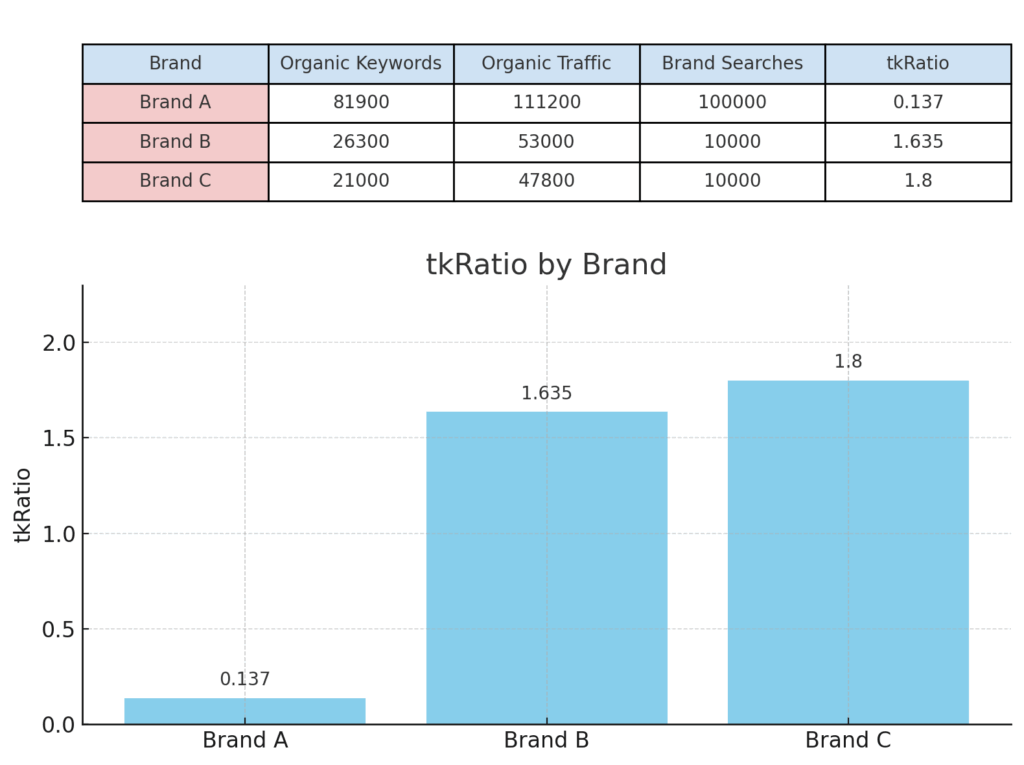
Brand A is the client, and at first look, they would think they’re way ahead in SEO and topical authority in organic search. However, upon running the tkRatio formula against their competition, you can see Brand C and Brand B are way ahead – getting much more traffic from generic terms that help drive new customers in search. While Brand A may not be as far behind as the tkRatio implies, the metric still uncovers critical SEO issues hidden by brand dominance.
Why It’s More Important Than Just SEO Traffic
tkRatio goes beyond typical SEO metrics like traffic and keyword count. At first glance, Brand A might feel confident due to its higher traffic and larger keyword footprint. But after adjusting for branded searches, it’s clear that their SEO visibility is limited and their competitors are winning on non-branded, high-intent terms.
Simply put – Brand B and Brand C are beating Brand A in broad topical authority and SEO fundamentals. tkRatio has pointed out a big issue for Brand A – their brand dominance is covering up much bigger issues with technical and on-site SEO that prevents them from getting more broad search traffic.
When To Use tkRatio
So, when would a company want to use tkRatio? It really comes down to four areas where marketing and SEO teams can review tkRatio to come up with holes in SEO and marketing –
- Competitive Audits: Use tkRatio to benchmark where your brand stands on earned vs. brand-driven traffic.
- Investment Prioritization: A low tkRatio signals weak non-branded SEO. Brand should spend time strengthening content and technical elements.
- Keyword Efficiency Analysis: Identify brands ranking well with fewer keywords and minimal brand lift.
- Tracking Changes Over Time: A declining tkRatio may signal over-reliance on brand searches or erosion in keyword performance.
Known Issues and Things to Consider
Like most SEO metrics, tkRatio isn’t perfect so always make some mental adjustments when using the formula. The metric is directionally correct with sources that surface data in the same way for all three metrics for the formula. Some things to consider –
- Brand search volume is too broadly grouped. Google reports search volume in large ranges, such as 1,000 to 10,000 and 10,000 to 100,000. If one brand gets 20,000 searches and another gets 9,000, they are placed in different buckets. This can distort tkRatio and make the higher-search brand look less effective than it really is.
- Defining brand keywords is not always clear. Should you count only exact brand names like “Nike,” or also include terms like “Nike running shoes”? Some brand names, like “Discount Shoes,” may unintentionally capture generic searches, inflating brand search volume.
- Traffic estimates are directional and not exact. Tools like Semrush and Ahrefs estimate traffic using keyword rankings and click-through data. These numbers can vary, so it’s important to use the same tool for all inputs when comparing tkRatio across brands.
tkRatio is a great tool for marketing and SEO teams to use to benchmark against the competition. Knowing where brand and where breadth and depth of keywords stand against your competitors can help drive SEO as well as overall marketing strategy. Need help with SEO? Contact Robert Drumm to have an SEO and Discovery Audit performed on your website.